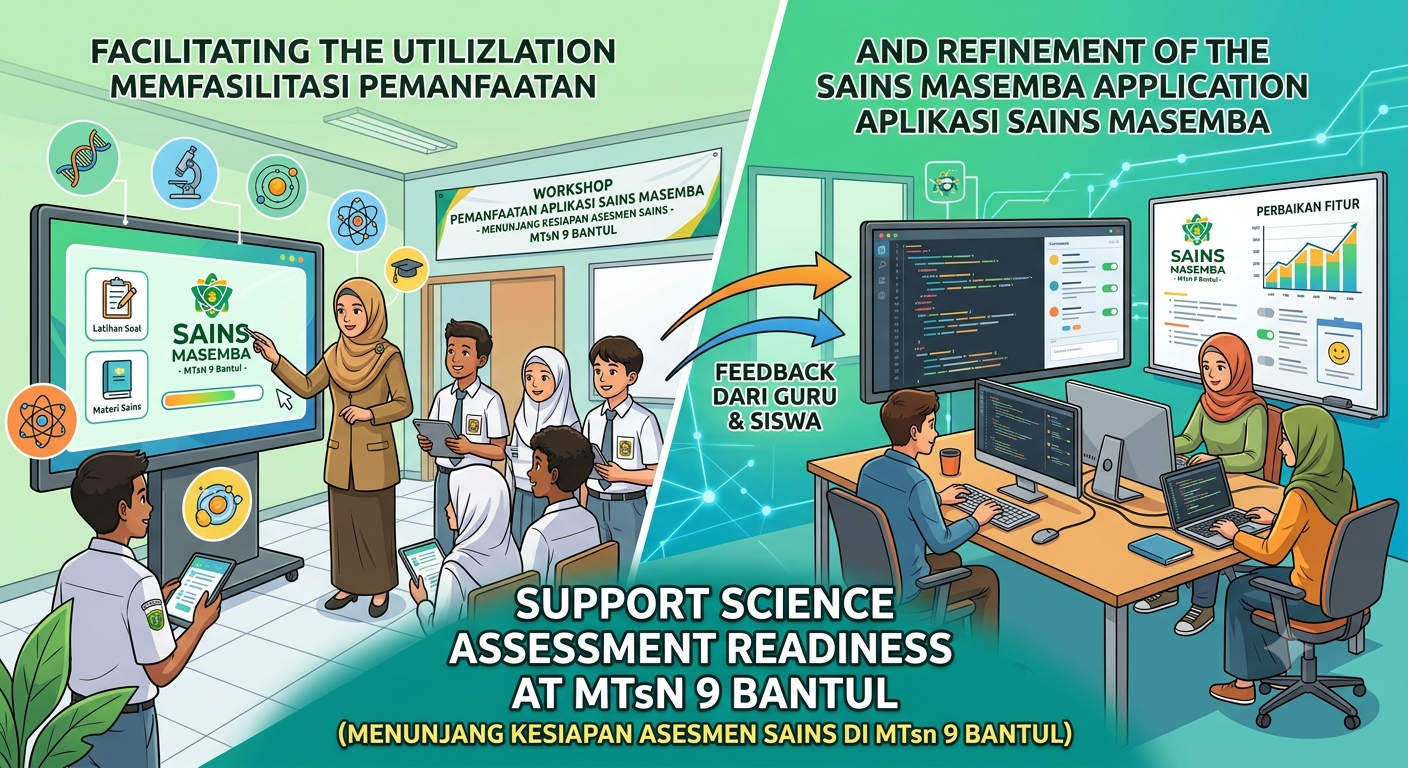
Facilitating the Utilization and Refinement of the Sains Masemba Application to Support Science Assessment Readiness at MTsN 9 Bantul
Keywords:
Sains Masemba application, digital science assessment, Participatory Action Research, user experienceAbstract
Design/methods/approach – The program employed Participatory Action Research through two cycles. Cycle I involved 49 ninth-grade students and one science teacher on 13–15 June 2026. Cycle II implemented application version 18 and involved 59 students and three teachers on 23–24 June 2026. Data were collected using four-point Likert questionnaires, open- and semi-open-ended questions, usage observations, and application documentation. The analysis included descriptive statistics, internal consistency testing, a Wilcoxon signed-rank test involving 49 students who participated in both cycles, and descriptive thematic coding.
Findings – Students’ mean response increased from 3.31, or 82.86% of the maximum score, in Cycle I to 3.81, or 95.17%, in Cycle II. Positive responses increased from 94.90% to 99.83%. Paired data showed an increase from 3.31 to 3.82, with 44 students improving, five remaining unchanged, and none declining. The difference was statistically significant (p < 0.001; r = 0.87). Teacher responses increased descriptively from 85.00% to 98.33%. Performance, access, and connectivity concerns decreased from 26.53% to 8.47%.
Research implications/limitations – The findings represent perceived usability rather than learning achievement. Future evaluations should include technical logs, task-completion data, and paired learning outcomes.
Originality/value – This program demonstrates how participatory feedback and iterative application refinement can improve digital science assessment experiences in a madrasah context.
References
Amemasor, S. K., Oppong, S. O., Ghansah, B., & Essel, D. D. (2025). A systematic review on the impact of teacher professional development on digital instructional integration and teaching practices. Frontiers in Education, 10, 1541031. https://doi.org/10.3389/feduc.2025.1541031
Baars, M., Khare, S., & Ridderstap, L. (2022). Exploring students’ use of a mobile application to support their self-regulated learning processes. Frontiers in Psychology, 13, 793002. https://doi.org/10.3389/fpsyg.2022.793002
Baum, F., MacDougall, C., & Smith, D. (2006). Participatory action research. Journal of Epidemiology and Community Health, 60(10), 854–857. https://doi.org/10.1136/jech.2004.028662
Bennett, R. E. (2011). Formative assessment: A critical review. Assessment in Education: Principles, Policy & Practice, 18(1), 5–25. https://doi.org/10.1080/0969594X.2010.513678
Black, P., & Wiliam, D. (2009). Developing the theory of formative assessment. Educational Assessment, Evaluation and Accountability, 21(1), 5–31. https://doi.org/10.1007/s11092-008-9068-5
Braun, V., & Clarke, V. (2021). One size fits all? What counts as quality practice in (reflexive) thematic analysis? Qualitative Research in Psychology, 18(3), 328–352. https://doi.org/10.1080/14780887.2020.1769238
de Sousa, E. B. G., Alexandre, B., Ferreira Mello, R., Pontual Falcão, T., Vesin, B., & Gašević, D. (2021). Applications of learning analytics in high schools: A systematic literature review. Frontiers in Artificial Intelligence, 4, 737891. https://doi.org/10.3389/frai.2021.737891
Johannsen, F., Knipp, M., Loy, T., Mirbabaie, M., Möllmann, N. R. J., Voshaar, J., et al. (2023). What impacts learning effectiveness of a mobile learning app focused on first-year students? Information Systems and e-Business Management, 21, 629–673. https://doi.org/10.1007/s10257-023-00644-0
Kantor Kementerian Agama Kabupaten Bantul. (2025a, 23 Oktober). Guru IPA MTsN 9 Bantul ikuti Try Out TKAD Dikpora 1 untuk tingkatkan kualitas soal dan pembelajaran.
Kantor Kementerian Agama Kabupaten Bantul. (2025b, 23 Oktober). Siswa kelas IX MTsN 9 Bantul akhiri Try Out TKAD Dikpora 1 dengan ujian IPA.
Kemmis, S., McTaggart, R., & Nixon, R. (2014). The action research planner: Doing critical participatory action research. Springer. https://doi.org/10.1007/978-981-4560-67-2
Michos, K., Schmitz, M. L., & Petko, D. (2023). Teachers’ data literacy for learning analytics: A central predictor for digital data use in upper secondary schools. Education and Information Technologies, 28, 14453–14471. https://doi.org/10.1007/s10639-023-11772-y
Mishra, P., & Koehler, M. J. (2006). Technological pedagogical content knowledge: A framework for teacher knowledge. Teachers College Record, 108(6), 1017–1054. https://doi.org/10.1111/j.1467-9620.2006.00684.x
OECD. (2023). PISA 2022 results (Volume I): The state of learning and equity in education. OECD Publishing. https://doi.org/10.1787/53f23881-en
Redecker, C. (2017). European framework for the digital competence of educators: DigCompEdu. Publications Office of the European Union. https://doi.org/10.2760/159770
Shute, V. J. (2008). Focus on formative feedback. Review of Educational Research, 78(1), 153–189. https://doi.org/10.3102/0034654307313795
Tavakol, M., & Dennick, R. (2011). Making sense of Cronbach’s alpha. International Journal of Medical Education, 2, 53–55. https://doi.org/10.5116/ijme.4dfb.8dfd
Downloads
Published
How to Cite
Issue
Section
License

This work is licensed under a Creative Commons Attribution-ShareAlike 4.0 International License.