Evaluating the Social Value of Corporate Social Responsibility through Social Return on Investment (SROI)
A Case Study of the Garitan Kalongliud Program at PT ANTAM (Persero) Tbk Gold Mining Business Unit
Keywords:
Corporate Social Responsibility, Social Return on Investment, Community Empowerment, Mining Industry, Sustainable Agriculture, Social Value, Sustainable DevelopmentAbstract
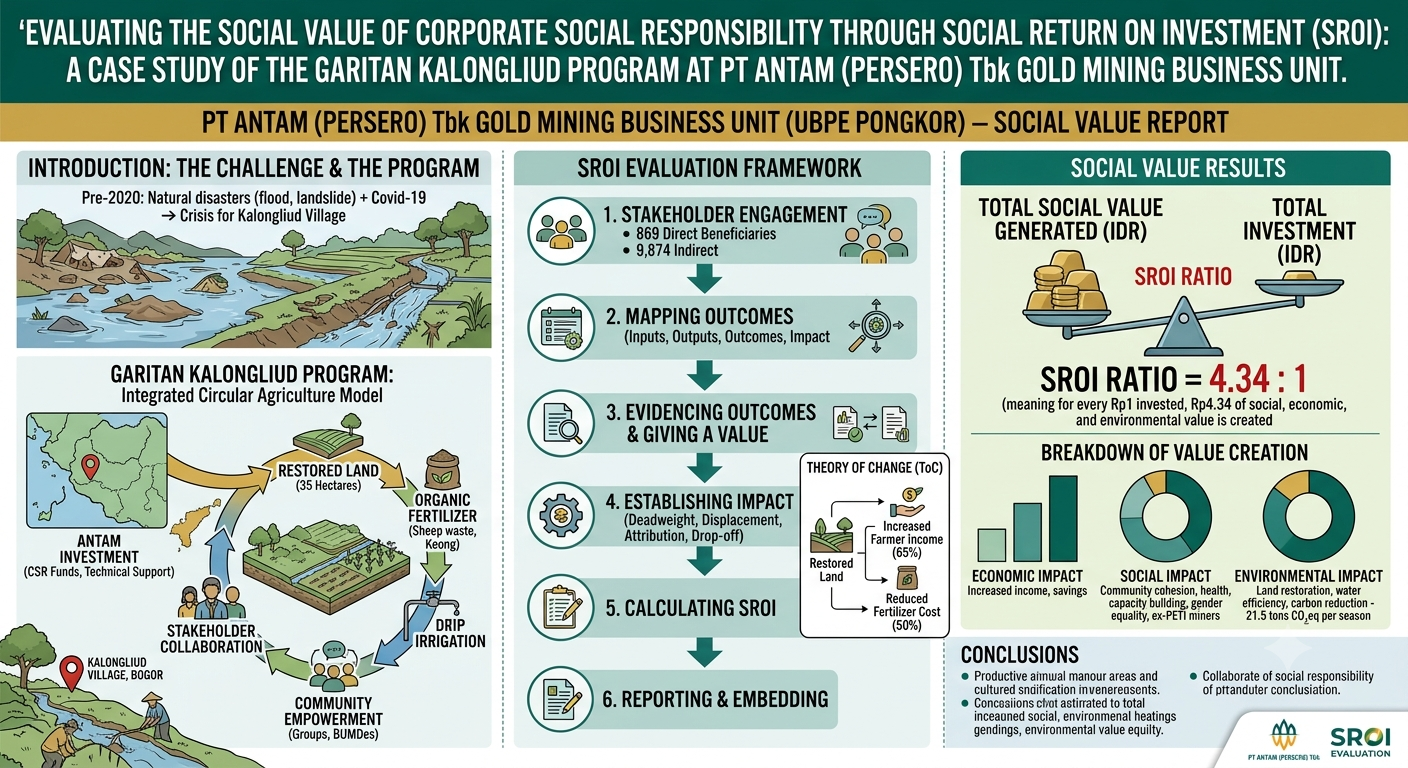
Purpose – Despite the increasing implementation of Corporate Social Responsibility (CSR) in the mining sector, empirical evidence quantifying the multidimensional social value generated by integrated community empowerment programs remains limited. This study evaluates the social value created by the Garitan Kalongliud CSR Program implemented by PT ANTAM (Persero) Tbk Gold Mining Business Unit using the Social Return on Investment (SROI) framework.
Design/methods/approach – A qualitative case study combined with the SROI framework was employed. Data were collected through semi-structured interviews, focus group discussions, field observations, and document reviews. The analysis followed the six stages of SROI, including stakeholder identification, Theory of Change development, outcome valuation using financial proxies, impact adjustment, and SROI ratio calculation.
Findings – The program generated significant social, economic, environmental, and wellbeing outcomes. With a total investment of IDR 276,450,415, the program created IDR 1,199,184,896 in social value, resulting in an SROI ratio of 4.34:1, indicating that every IDR 1.00 invested generated IDR 4.34 in social value. Key outcomes included increased household income, reduced agricultural production costs, strengthened farmer institutions, improved community capacity, and greater adoption of sustainable agricultural practices.
Research implications/limitations – This study is limited to a single CSR case in Indonesia, which may restrict the generalizability of the findings. Future research should compare SROI across different mining CSR programs and regions.
Originality/value – This study extends the application of the SROI framework to an integrated circular agriculture CSR program in the mining sector and provides empirical evidence that productive, community-based CSR initiatives create multidimensional social value, offering practical insights for designing more effective and sustainable CSR strategies.
References
Agus, A. (2020). Practicing Corporate Social Responsibility for Community Empowerment: A Case of a Mining Company in Indonesia. Randwick International of Social Science Journal, 1(3), 608–618.
Arvidson, M., Lyon, F., McKay, S., & Moro, D. (2013). Valuing the social? The nature and controversies of measuring social return on investment (SROI). Voluntary Sector Review, 4(1), 3–18.
Boutilier, R. G. (2014). Frequently Asked Questions About the Social Licence to Operate. Impact Assessment and Project Appraisal, 32(4), 263–272.
Creswell, J. W., & Creswell, J. D. (2018). Research Design: Qualitative, Quantitative, and Mixed Methods Approaches (5th ed.). Thousand Oaks, CA: Sage Publications.
Carroll, A. B. (1991). The Pyramid of Corporate Social Responsibility: Toward the Moral Management of Organizational Stakeholders. Business Horizons, 34(4), 39–48.
Freeman, R. E. (1984). Strategic Management: A Stakeholder Approach. Boston: Pitman.
Hilson, G. (2012). Corporate Social Responsibility in the extractive industries.
Jenkins, H. (2004). Corporate Social Responsibility and the Mining Industry
Jenkins, H., & Yakovleva, N. (2006). Corporate social responsibility in the mining industry.
Laurence, D. (2006). Optimisation of the mine closure process. Journal of Cleaner Production, 14(3–4), 285–298.
Millar, R., & Hall, K. (2013). Social Return on Investment (SROI) and Performance Measurement. Public Management Review, 15(6), 923–941.
Nicholls, J., Lawlor, E., Neitzert, E., & Goodspeed, T. (2012). A Guide to Social Return on Investment. The SROI Network.
Porter, M. E., & Kramer, M. R. (2011). Creating Shared Value. Harvard Business Review, 89(1–2), 62–77.
Social Value International. (2012). A Guide to Social Return on Investment. Liverpool: Social Value International.
Santoso, T. I., Octavenda, C. P., & Alamsyah, M. N. (2025). corporate social responsibility and community empowerment in the mining sector: post-mining closure and sustainable development in Gunung Pongkor, Indonesia. International Journal of Islamic Business and Management Review, 5(1), 125-136.
Susatyo, A., Anna, Z., Hasyir, D. A., & Komarulzaman, A. (2025). ANALYZING THE SOCIAL RETURN ON INVESTMENT OF THE UMA PALAK LESTARI ECOTOURISM CSR PROGRAM OF PT. PERTAMINA PATRA NIAGA DPPU NGURAH RAI. Sosiohumaniora, 27(1).
UGM, S. (2025). Laporan Social Mapping PT ANTAM Tbk UBPE Pongkor. Yogyakarta: Universitas Gadjah Mada.
UGM, S. (2025). SROI Garitan Kalongliud. Yogyakarta: Universitas Gadjah Mada.
Widhagdha, M. F., Muktiyo, W., Kartono, D. T., & Padmanindrum, D. (2025). Valuing Sustainability Impact: A Comparative Study of Impact Measurement of Community Empowerment Programs Based on Social Return on Investment (SROI) in Oil and Gas Refinery Companies in Indonesia. International Journal of Applied Sciences & Development, 4, 119-126.
Yin, R. K. (2018). Case Study Research and Applications: Design and Methods (6th ed.). Thousand Oaks, CA: Sage Publications.
Downloads
Published
How to Cite
Issue
Section
License
Copyright (c) 2026 Bima Cendikia : Journal of Community Engagement and Empowerment

This work is licensed under a Creative Commons Attribution-ShareAlike 4.0 International License.