Implementing the Merdeka Curriculum in Islamic Senior High Schools in Aceh
Challenges of Integrating Islamic Education and Local Wisdom
Keywords:
Merdeka Curriculum, Islamic education, Local Wisdom, Madrasah Aliyah, AcehAbstract
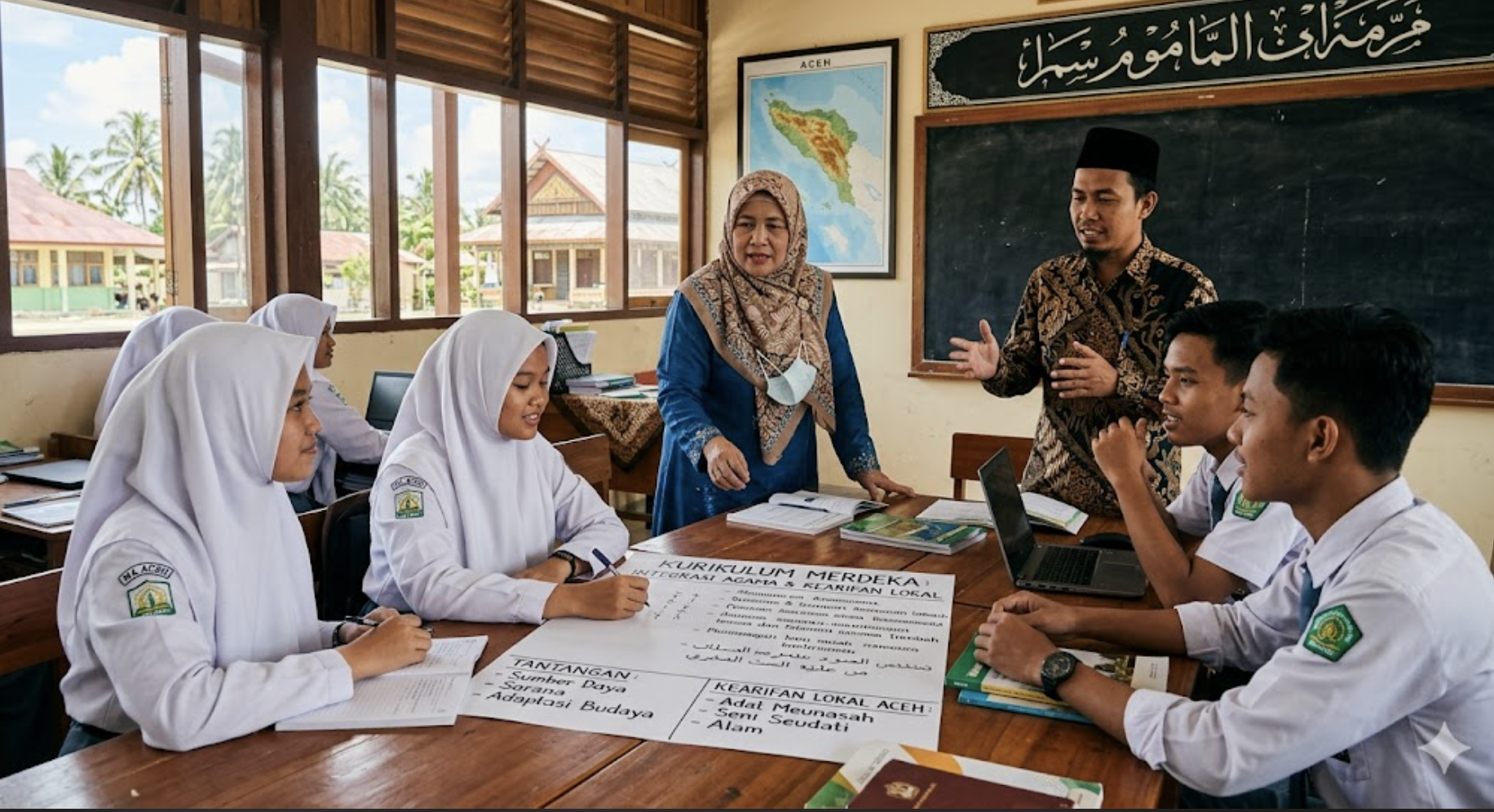
Purpose – This study examines the implementation of the Merdeka Curriculum in Islamic senior high schools (Madrasah Aliyah) in Aceh, focusing on the integration of Islamic educational values and local wisdom into classroom practices. The study addresses the need for contextualized Islamic education that aligns with national curriculum reforms while preserving regional cultural identity.
Design/methods/approach – A qualitative case study approach was employed involving four Madrasah Aliyah in Aceh. Data were collected through semi-structured interviews with 18 teachers and principals, classroom observations, and curriculum document analysis. The data were analyzed thematically to identify implementation patterns and challenges.
Findings – The findings reveal that 76% of teachers integrated Acehnese cultural values into project-based learning and character education activities. The curriculum encouraged contextual learning and strengthened students’ religious and social engagement. However, limited pedagogical training, insufficient digital infrastructure, and difficulties in designing culturally responsive teaching modules hindered effective implementation.
Research implications/limitations – The study was limited to selected madrasahs in Aceh and may not represent other Islamic schools in Indonesia. The findings suggest the importance of continuous teacher professional development and institutional support for curriculum adaptation in culturally diverse regions.
Originality/value – This study contributes to the discourse on Islamic education reform by demonstrating how local wisdom can be integrated into contemporary curriculum implementation within Islamic educational institutions.
References
Abdullah, M. A. (2020). Islamic studies in higher education in Indonesia: Challenges and prospects. Yogyakarta: Pustaka Pelajar.
Ainissyifa, H. (2017). Pendidikan karakter dalam perspektif pendidikan Islam. Jurnal Pendidikan Universitas Garut, 8(1), 1–26.
Alim, A. (2021). Integration of local wisdom in Islamic education curriculum in Indonesia. Jurnal Pendidikan Islam, 7(2), 145–160.
Anwar, C. (2022). Contextual learning in Islamic schools through Merdeka Curriculum implementation. Tadris: Jurnal Pendidikan Islam, 17(1), 45–58.
Arifin, Z. (2019). Curriculum development in Indonesian Islamic education institutions. Al-Ta’lim Journal, 26(3), 210–222.
Azra, A. (2015). Pendidikan Islam: Tradisi dan modernisasi di tengah tantangan milenium III. Jakarta: Kencana.
Baharun, H. (2018). Strengthening character education through Islamic values in madrasah. Jurnal Pendidikan Islam, 4(1), 21–34.
Basri, H. (2021). The implementation of student-centered learning in Islamic education. International Journal of Islamic Educational Studies, 5(2), 90–105.
Bourdieu, P. (1990). The logic of practice. Stanford University Press.
Creswell, J. W. (2018). Research design: Qualitative, quantitative, and mixed methods approaches (5th ed.). Sage Publications.
Dakir, D. (2020). Local wisdom-based Islamic education in Aceh. Jurnal Ilmiah Peuradeun, 8(3), 455–470.
Departemen Agama Republik Indonesia. (2021). Pedoman implementasi kurikulum merdeka pada madrasah. Jakarta: Direktorat KSKK Madrasah.
Dewey, J. (1938). Experience and education. Macmillan.
Fadli, M. R. (2022). Challenges of digital transformation in Indonesian Islamic schools. Edukasia Islamika, 7(1), 77–93.
Fathurrohman, M. (2017). Islamic education and local culture integration in Indonesian society. Qudus International Journal of Islamic Studies, 5(2), 221–240.
Freire, P. (1970). Pedagogy of the oppressed. Continuum.
Hadi, S. (2021). Teacher readiness toward the implementation of Merdeka Curriculum. Jurnal Pendidikan Madrasah, 6(2), 133–147.
Hakim, L. (2020). Educational innovation in Indonesian madrasahs during curriculum reform. Tarbiyah: Jurnal Pendidikan Islam, 27(1), 55–69.
Hamid, A. (2021). Strengthening Islamic character education through local wisdom values. Jurnal Pendidikan Karakter, 11(2), 198–210.
Hidayat, K. (2019). Pendidikan Islam dan tantangan globalisasi. Jakarta: Prenadamedia Group.
Hosnan, M. (2014). Pendekatan saintifik dan kontekstual dalam pembelajaran abad 21. Bogor: Ghalia Indonesia.
Kemendikbud RI. (2022). Kurikulum Merdeka: Konsep dan implementasi. Jakarta: Kementerian Pendidikan, Kebudayaan, Riset, dan Teknologi.
Khoirurrijal, K. (2022). Pengembangan kurikulum merdeka. Malang: Literasi Nusantara.
Lickona, T. (2012). Educating for character. Bantam Books.
Madjid, N. (2008). Islam, doktrin, dan peradaban. Jakarta: Paramadina.
Miles, M. B., Huberman, A. M., & Saldaña, J. (2014). Qualitative data analysis: A methods sourcebook (3rd ed.). Sage Publications.
Moleong, L. J. (2018). Metodologi penelitian kualitatif. Bandung: Remaja Rosdakarya.
Mulyasa, E. (2021). Implementasi kurikulum merdeka belajar. Jakarta: Bumi Aksara.
Musanna, A. (2017). Indigenization of education: Rationalization of the need for contextual-based education. Jurnal Pendidikan dan Kebudayaan, 2(1), 117–133.
Nata, A. (2016). Ilmu pendidikan Islam. Jakarta: Prenadamedia Group.
Nugroho, R. (2020). Policy implementation of curriculum reform in Indonesian education. Journal of Social Studies Education Research, 11(3), 172–188.
Prasetyo, M. A. M. (2021). Educational leadership in Islamic schools during curriculum transformation. Cendekia: Jurnal Kependidikan dan Kemasyarakatan, 19(2), 311–327.
Rahman, F. (1982). Islam and modernity: Transformation of an intellectual tradition. University of Chicago Press.
Rosyada, D. (2017). Madrasah dan profesionalisme guru dalam arus dinamika pendidikan Islam di Indonesia. Jakarta: Kencana.
Sanjaya, W. (2015). Strategi pembelajaran berorientasi standar proses pendidikan. Jakarta: Prenadamedia Group.
Schein, E. H. (2010). Organizational culture and leadership (4th ed.). Jossey-Bass.
Schunk, D. H. (2012). Learning theories: An educational perspective (6th ed.). Pearson Education.
Setiawan, A. (2022). Local wisdom integration in Islamic learning during curriculum transformation. Jurnal Pendidikan Agama Islam, 19(1), 65–80.
Sugiyono. (2019). Metode penelitian pendidikan: Pendekatan kuantitatif, kualitatif, dan R&D. Bandung: Alfabeta.
Suyadi, S. (2020). Merdeka belajar and the transformation of Islamic education in Indonesia. International Journal of Instruction, 13(4), 161–176.
Tilaar, H. A. R. (2012). Perubahan sosial dan pendidikan. Jakarta: Rineka Cipta.
UNESCO. (2021). Reimagining our futures together: A new social contract for education. UNESCO Publishing.
Wahyuni, S. (2021). Teacher adaptation toward independent learning curriculum in Islamic schools. Jurnal Pendidikan Islam Indonesia, 5(2), 98–112.
Yusuf, M. (2020). Cultural values and Islamic education practices in Acehnese society. Jurnal Ilmiah Islam Futura, 20(1), 55–70.
Published
How to Cite
Issue
Section
License
Copyright (c) 2026 SettingsCut Aisyha Ramadhani

This work is licensed under a Creative Commons Attribution-ShareAlike 4.0 International License.
Authors who publish with Al Huda: Journal of Islamic Education and Society agree to the following terms:
- Authors retain copyright and grant the journal right of first publication with the work simultaneously licensed under a Creative Commons Attribution-ShareAlike 4.0 International License that allows others to share the work with an acknowledgment of the work's authorship and initial publication in this journal.
- Authors are able to enter into separate, additional contractual arrangements for the non-exclusive distribution of the journal's published version of the work (e.g., post it to an institutional repository or publish it in a book), with an acknowledgment of its initial publication in this journal.
- Authors are permitted and encouraged to post their work online (e.g., in institutional repositories or on their website) prior to and during the submission process, as it can lead to productive exchanges, as well as earlier and greater citation of published work (See The Effect of Open Access).