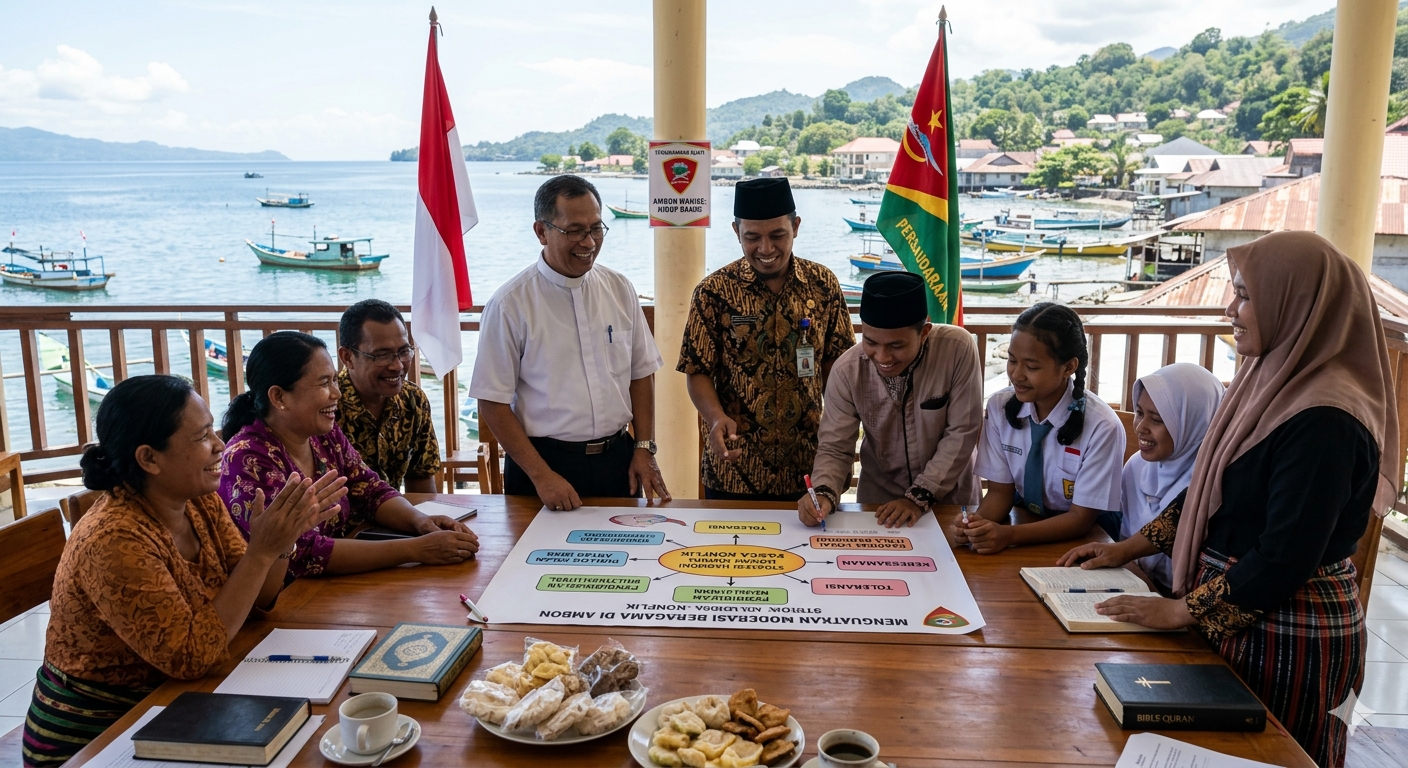
Strengthening Religious Moderation through Multicultural Islamic Education in Ambon
Strategies for Post-Conflict Social Harmony
Keywords:
religious moderation, multicultural Islamic education, social harmony, Ambon, toleranceAbstract
Purpose – This study investigates the role of multicultural Islamic education in strengthening religious moderation and promoting post-conflict social harmony in Ambon. The research responds to the continuing need for educational strategies that foster tolerance and peaceful coexistence in plural societies.
Design/methods/approach – The study adopted a qualitative phenomenological approach involving interviews with 12 Islamic education teachers, six religious leaders, and 24 students from Islamic schools in Ambon. Observations and institutional documents were also analyzed to support data triangulation.
Findings – The findings indicate that multicultural Islamic education significantly improved students’ attitudes toward tolerance and interreligious interaction. Approximately 81% of participants acknowledged that cross-cultural learning activities enhanced mutual understanding among religious communities. Educational programs emphasizing moderation, dialogue, and collaborative social engagement contributed positively to social cohesion. Nevertheless, the study identified challenges related to limited multicultural teaching materials and residual social stereotypes within certain communities.
Research implications/limitations – The research focused on selected institutions in Ambon, limiting broader generalizability. The study implies that multicultural-based Islamic education can serve as an effective framework for peacebuilding in post-conflict regions.
Originality/value – This study offers empirical evidence regarding the contribution of Islamic education to strengthening religious moderation and rebuilding social harmony in post-conflict societies.
References
Abdullah, M. A. (2020). Islamic studies in higher education in Indonesia: Challenges and prospects. Yogyakarta: Pustaka Pelajar.
Ainissyifa, H. (2017). Pendidikan karakter dalam perspektif pendidikan Islam. Jurnal Pendidikan Universitas Garut, 8(1), 1–26.
Alim, A. (2021). Integration of local wisdom in Islamic education curriculum in Indonesia. Jurnal Pendidikan Islam, 7(2), 145–160.
Anwar, C. (2022). Contextual learning in Islamic schools through Merdeka Curriculum implementation. Tadris: Jurnal Pendidikan Islam, 17(1), 45–58.
Arifin, Z. (2019). Curriculum development in Indonesian Islamic education institutions. Al-Ta’lim Journal, 26(3), 210–222.
Published
How to Cite
Issue
Section
License

This work is licensed under a Creative Commons Attribution-ShareAlike 4.0 International License.
Authors who publish with Al Huda: Journal of Islamic Education and Society agree to the following terms:
- Authors retain copyright and grant the journal right of first publication with the work simultaneously licensed under a Creative Commons Attribution-ShareAlike 4.0 International License that allows others to share the work with an acknowledgment of the work's authorship and initial publication in this journal.
- Authors are able to enter into separate, additional contractual arrangements for the non-exclusive distribution of the journal's published version of the work (e.g., post it to an institutional repository or publish it in a book), with an acknowledgment of its initial publication in this journal.
- Authors are permitted and encouraged to post their work online (e.g., in institutional repositories or on their website) prior to and during the submission process, as it can lead to productive exchanges, as well as earlier and greater citation of published work (See The Effect of Open Access).