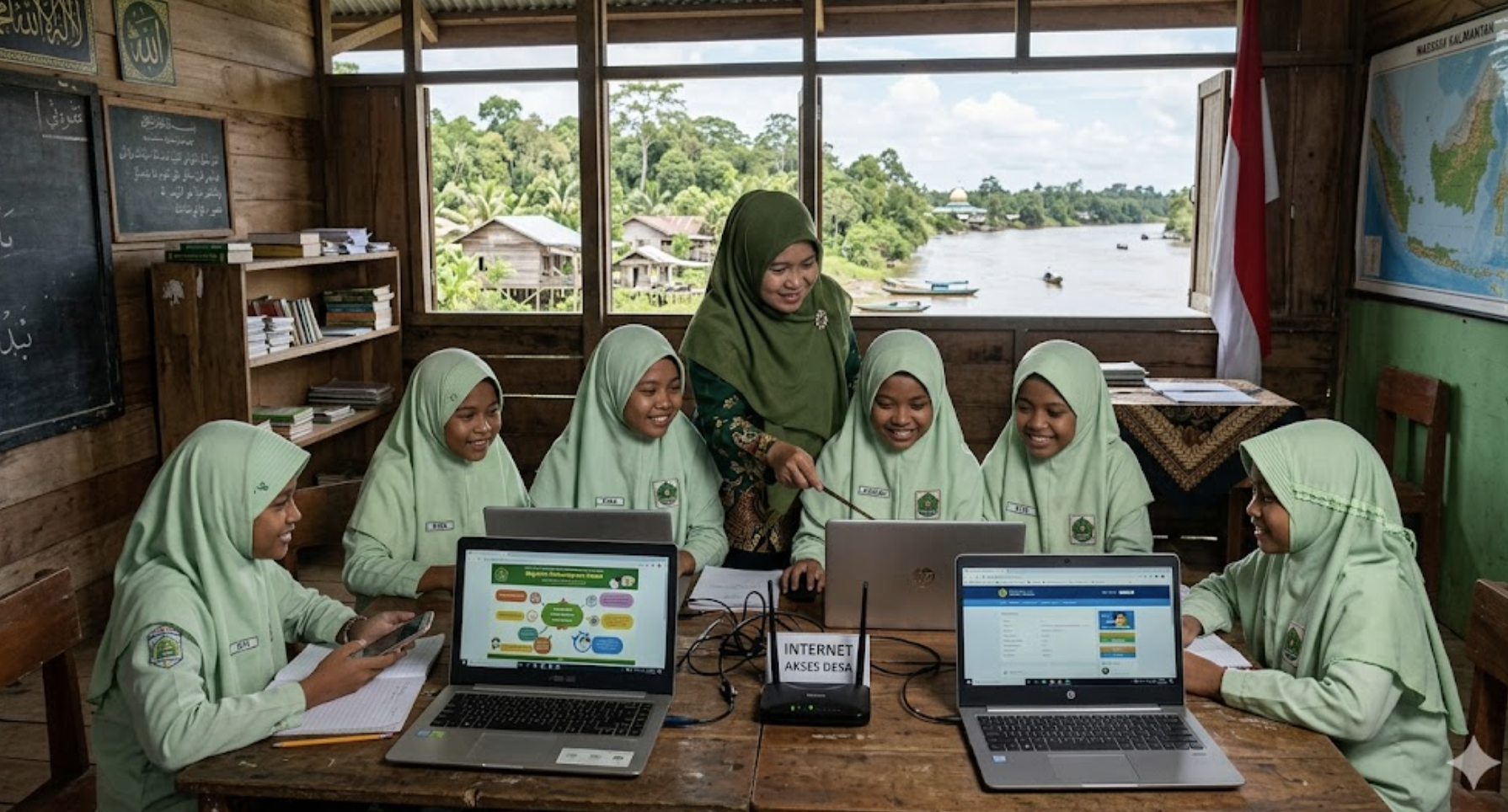
Digital Transformation of Islamic Religious Education in Remote Madrasahs of Kalimantan
Opportunities and Challenges
Keywords:
digital transformation, Islamic Religious Education, madrasah, remote education, KalimantanAbstract
Purpose – This study explores the digital transformation of Islamic Religious Education in remote madrasahs in Kalimantan, focusing on opportunities and challenges in implementing technology-based learning in geographically isolated areas. The study addresses disparities in educational access and digital readiness in Islamic schools.
Design/methods/approach – A mixed-methods design was employed involving surveys of 146 teachers and students from six madrasahs, followed by interviews and classroom observations. Quantitative data were analyzed statistically, while qualitative findings were interpreted thematically.
Findings – The results show that digital learning improved student participation and learning flexibility, with 72% of respondents reporting increased engagement in Islamic Religious Education classes. Digital platforms facilitated access to learning resources and assessment activities. However, unstable internet access, limited technological facilities, and low digital literacy among teachers remained significant barriers to implementation.
Research implications/limitations – The study was limited to remote madrasahs in several regions of Kalimantan and may not fully represent other rural Islamic educational contexts. The findings imply the need for infrastructure development and targeted digital training programs for educators.
Originality/value – This study provides important insights into the realities of digital transformation in Islamic education within remote Indonesian contexts, contributing to discussions on educational equity and digital inclusion.
References
Koswara, A., Darmanto, D., Wigati, I., & Suhadi, S. (2026). Digital transformation in Islamic religious education: Opportunities, challenges, and strategic solutions. Jurnal Sustainable, 9(2). https://doi.org/10.32923/2br4mg47
Yahya, A. (2025). Peluang dan tantangan pembelajaran pendidikan agama Islam (PAI) di era digital. Pendas: Jurnal Ilmiah Pendidikan Dasar, 10(2). https://doi.org/10.23969/jp.v10i02.24990
Ramadhona, R., Harto, K., & Amilda, A. (2025). Revolusi digital: Transformasi teknologi informasi dalam pendidikan Islam modern. Pendas: Jurnal Ilmiah Pendidikan Dasar, 10(2). https://doi.org/10.23969/jp.v10i02.26522
Malik, A. F. I., Anwar, M. A. M., & Wahyudin, A. (2023). Peran transformasi digital dalam optimalisasi tata kelola lembaga pendidikan berbasis keagamaan. Salimiya: Jurnal Studi Ilmu Keagamaan Islam, 4(4). https://doi.org/10.58401/salimiya.v4i4.2706
Published
How to Cite
Issue
Section
License
Copyright (c) 2026 Nurul Fadilah, S.

This work is licensed under a Creative Commons Attribution-ShareAlike 4.0 International License.
Authors who publish with Al Huda: Journal of Islamic Education and Society agree to the following terms:
- Authors retain copyright and grant the journal right of first publication with the work simultaneously licensed under a Creative Commons Attribution-ShareAlike 4.0 International License that allows others to share the work with an acknowledgment of the work's authorship and initial publication in this journal.
- Authors are able to enter into separate, additional contractual arrangements for the non-exclusive distribution of the journal's published version of the work (e.g., post it to an institutional repository or publish it in a book), with an acknowledgment of its initial publication in this journal.
- Authors are permitted and encouraged to post their work online (e.g., in institutional repositories or on their website) prior to and during the submission process, as it can lead to productive exchanges, as well as earlier and greater citation of published work (See The Effect of Open Access).