
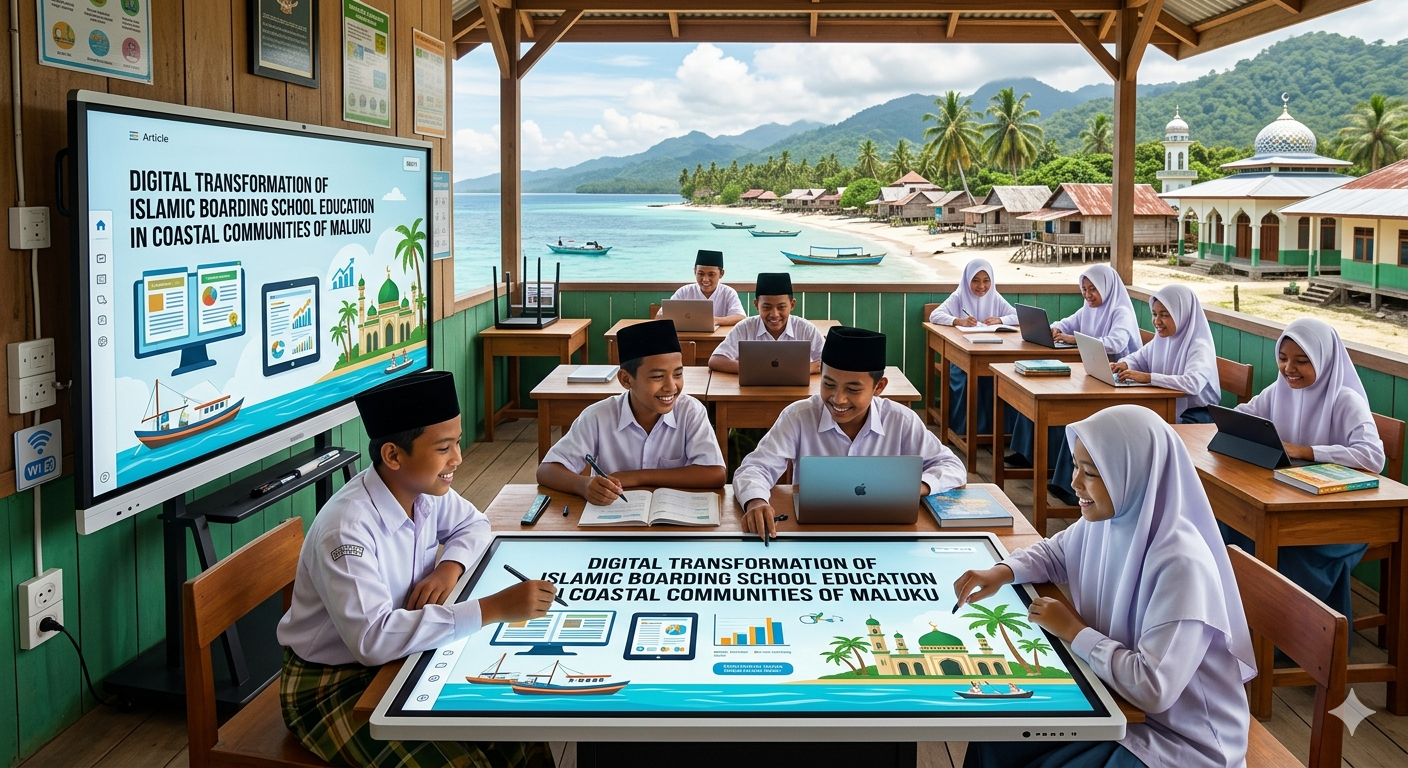
Digital Transformation of Islamic Boarding School Education in Coastal Communities of Maluku
Keywords:
Digital Transformation, Islamic Boarding School, Islamic Education, coastal community, MalukuAbstract
Purpose – This study examines the implementation of digital transformation in Islamic boarding school education within coastal communities of Maluku. The research aims to identify how digital learning innovations support educational accessibility and improve students’ religious and technological competencies in geographically isolated areas.
Design/methods/approach – The study employed a qualitative descriptive approach involving interviews with pesantren leaders, teachers, and students from three Islamic boarding schools in Maluku. Data collection also included classroom observations and document analysis related to digital learning activities.
Findings – The findings reveal that digital learning integration significantly improved students’ access to Islamic educational resources and online learning platforms. Approximately 74% of participants reported increased learning motivation and broader educational interaction through digital media. However, limited internet infrastructure and insufficient technological training for educators remained major challenges in implementing sustainable digital education.
Research implications/limitations – This study was limited to several coastal pesantren communities in Maluku and may not fully represent other rural Islamic educational institutions in Indonesia. The findings imply the importance of strengthening technological infrastructure and digital literacy training for educators in remote areas.
Originality/value – This study contributes to the discourse on Islamic education and digital transformation by providing empirical evidence regarding the adaptation of pesantren education to technological development within coastal minority communities.
References
Abdullah, M. (2022). Digital learning in Islamic education. Jakarta: Prenada Media.
Ahmad, R., & Yusuf, M. (2021). Technology integration in pesantren education. Journal of Islamic Studies, 12(2), 45–59.
Ali, S. (2020). Educational transformation in rural Indonesia. Bandung: Alfabeta.
Anwar, H. (2021). Islamic education and digital literacy. Journal of Education Research, 8(1), 33–48.
Arifin, Z. (2023). Pesantren modernization in Indonesia. Yogyakarta: Deepublish.
Azra, A. (2019). Pendidikan Islam: Tradisi dan modernisasi. Jakarta: Kencana.
Bahri, M. (2020). Coastal education communities in eastern Indonesia. Journal of Social Education, 5(3), 66–77.
Basri, H., & Karim, F. (2021). ICT in Islamic schools. Indonesian Journal of Education, 9(2), 88–99.
Fauzi, I. (2022). Online learning adaptation during pandemic. Journal of Digital Education, 11(4), 101–115.
Hakim, L. (2020). Technology challenges in remote schools. Jakarta: RajaGrafindo.
Hamzah, A. (2023). Islamic education in minority regions. Journal of Islamic Thought, 6(2), 55–68.
Hasanah, U. (2021). Digital competence among teachers. Educational Review, 14(3), 72–84.
Hidayat, T. (2022). Internet access inequality in Indonesia. Journal of Technology and Society, 10(1), 19–31.
Ibrahim, M. (2020). Pesantren and community empowerment. Bandung: Remaja Rosdakarya.
Idris, S. (2021). Learning innovation in Islamic schools. Journal of Islamic Pedagogy, 13(1), 45–58.
Imran, K. (2023). Educational technology policy in Indonesia. Jakarta: Kompas Press.
Ismail, N. (2022). Coastal Muslim communities and education. Journal of Cultural Studies, 7(2), 60–73.
Karim, A. (2021). Teacher readiness for digital learning. Journal of Educational Technology, 9(4), 91–105.
Latif, H. (2020). Islamic boarding schools and modernization. Yogyakarta: Pustaka Pelajar.
Maulana, R. (2022). Community-based Islamic education. Journal of Social Religion, 8(1), 37–50.
Munir, A. (2021). Challenges of rural education. Journal of Indonesian Education, 15(2), 66–78.
Natsir, M. (2023). Technology and Islamic values. Journal of Religion and Society, 11(3), 82–94.
Nurhayati, S. (2020). Educational access in coastal areas. Journal of Rural Development, 5(1), 22–35.
Prasetyo, D. (2021). Digital pesantren movement. Journal of Islamic Innovation, 4(2), 49–61.
Rahman, A. (2022). E-learning in Indonesian madrasahs. Educational Journal, 10(3), 57–70.
Ramadhani, F. (2020). Digital literacy among students. Journal of Modern Education, 6(2), 41–53.
Ridwan, M. (2021). Islamic education policy reform. Jakarta: Erlangga.
Rizki, A. (2023). Technology-based learning methods. Journal of Learning Sciences, 9(1), 88–100.
Saefullah, U. (2020). Community participation in education. Journal of Civic Education, 3(2), 27–39.
Sari, N. (2022). Digital transformation in schools. Journal of Educational Management, 14(1), 52–64.
Setiawan, B. (2021). Educational inequality in Indonesia. Bandung: Humaniora.
Subhan, M. (2020). Islamic education and globalization. Journal of Religious Education, 8(3), 71–85.
Sudirman, A. (2022). Teacher adaptation in online learning. Journal of Education Practice, 13(2), 44–57.
Syafii, I. (2021). Digital communication in pesantren. Journal of Islamic Communication, 5(1), 30–43.
Wahyudi, D. (2023). Infrastructure development and education. Journal of National Development, 7(2), 67–79.
Wibowo, H. (2021). Learning innovation in Islamic institutions. Journal of Contemporary Education, 10(2), 58–72.
Yasin, M. (2020). Technology access in eastern Indonesia. Journal of Regional Studies, 6(3), 49–60.
Yusuf, K. (2022). Islamic education and social change. Journal of Islamic Research, 12(1), 33–46.
Zainuddin, A. (2021). Rural school digitalization. Journal of Education Policy, 11(2), 74–86.
Zuhri, F. (2023). Future of pesantren education. Jakarta: Prenadamedia.
Published
How to Cite
Issue
Section
License

This work is licensed under a Creative Commons Attribution-ShareAlike 4.0 International License.
Authors who publish with Al Huda: Journal of Islamic Education and Society agree to the following terms:
- Authors retain copyright and grant the journal right of first publication with the work simultaneously licensed under a Creative Commons Attribution-ShareAlike 4.0 International License that allows others to share the work with an acknowledgment of the work's authorship and initial publication in this journal.
- Authors are able to enter into separate, additional contractual arrangements for the non-exclusive distribution of the journal's published version of the work (e.g., post it to an institutional repository or publish it in a book), with an acknowledgment of its initial publication in this journal.
- Authors are permitted and encouraged to post their work online (e.g., in institutional repositories or on their website) prior to and during the submission process, as it can lead to productive exchanges, as well as earlier and greater citation of published work (See The Effect of Open Access).