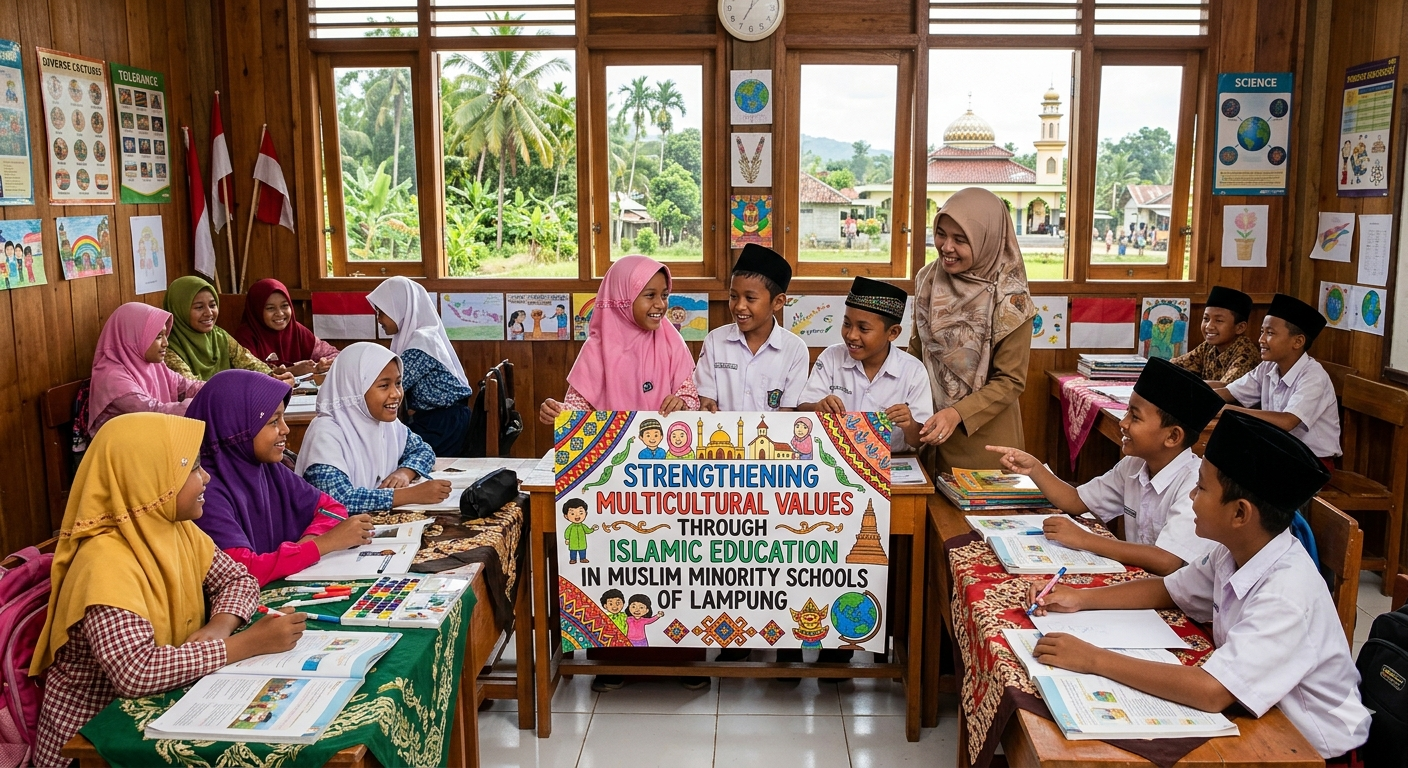
Strengthening Multicultural Values through Islamic Education in Muslim Minority Schools of Lampung
Keywords:
multicultural education, Islamic education, tolerance, Muslim minority, LampungAbstract
Purpose – This study explores the role of Islamic education in strengthening multicultural values among Muslim minority school communities in Lampung. The research focuses on how inclusive religious learning promotes tolerance and social harmony in multicultural educational settings.
Design/methods/approach – A qualitative case study approach was employed through interviews with teachers, principals, students, and community leaders from minority Muslim schools in Lampung. Observations and institutional document reviews were also conducted to support data analysis.
Findings – The findings demonstrate that multicultural-based Islamic education encouraged students to develop tolerant attitudes, respect for cultural diversity, and collaborative social interaction. Approximately 81% of respondents stated that multicultural learning activities improved interreligious understanding among students. Nevertheless, limited multicultural teaching materials and varying parental perspectives on religious diversity became obstacles in the implementation process.
Research implications/limitations – The research focused only on selected minority schools in Lampung, limiting broader generalization to other educational contexts. The findings suggest the need for culturally adaptive Islamic education curricula to strengthen multicultural awareness in schools.
Originality/value – This study enriches the literature on multicultural Islamic education by presenting empirical insights into the contribution of religious education toward social integration within minority educational environments.
References
Banks, J. A. (2015). Cultural diversity and education. Routledge.
Abdullah, M. (2021). Islamic multicultural education. Jakarta: Kencana.
Ahmad, F. (2022). Tolerance in Indonesian schools. Journal of Education, 12(2), 45–57.
Ali, R. (2020). Religious harmony in multicultural societies. Bandung: Alfabeta.
Anwar, H. (2021). Islamic education and tolerance. Journal of Islamic Studies, 9(1), 30–44.
Arifin, Z. (2022). Diversity and Islamic learning. Journal of Social Education, 11(3), 66–78.
Azra, A. (2019). Pendidikan Islam multikultural. Jakarta: Prenada Media.
Basri, M. (2023). Minority Muslim communities in Indonesia. Journal of Cultural Research, 8(2), 50–62.
Fauzi, I. (2021). Character education and tolerance. Journal of Civic Education, 7(4), 80–93.
Hakim, L. (2020). Religious moderation in schools. Yogyakarta: Deepublish.
Hamid, A. (2021). Social cohesion through education. Journal of Sociology Education, 6(2), 38–49.
Hasanah, U. (2022). Multicultural curriculum development. Journal of Curriculum Studies, 13(1), 55–67.
Hidayat, M. (2023). Minority education in Lampung. Journal of Regional Education, 10(2), 77–88.
Ibrahim, K. (2020). Inclusive Islamic education. Bandung: Humaniora.
Idris, T. (2021). Student tolerance attitudes. Journal of Educational Psychology, 5(3), 60–72.
Imran, S. (2022). Diversity in Indonesian classrooms. Journal of Learning Studies, 8(2), 44–56.
Ismail, H. (2020). Interreligious dialogue in schools. Journal of Religion and Society, 7(1), 28–39.
Karim, F. (2023). Islamic values and multiculturalism. Journal of Islamic Thought, 9(4), 91–104.
Latif, A. (2021). Education for peacebuilding. Jakarta: Erlangga.
Mahmud, R. (2022). Social integration through Islamic education. Journal of Social Harmony, 6(1), 33–45.
Maulana, Y. (2020). Muslim minorities in Southeast Asia. Journal of Asian Studies, 4(2), 40–51.
Munir, Z. (2021). Tolerance education strategies. Journal of Contemporary Education, 9(3), 57–69.
Nisa, C. (2022). Multicultural learning approaches. Journal of Teaching Innovation, 11(1), 47–59.
Nurhayati, S. (2020). Community participation in schools. Journal of Social Development, 5(2), 31–42.
Prasetyo, D. (2023). Islamic education and citizenship. Journal of Civic Studies, 8(1), 62–75.
Rahman, A. (2021). Religious pluralism in Indonesia. Journal of Islamic Civilization, 10(2), 73–85.
Ramadhani, N. (2020). Character building in education. Journal of Pedagogy, 6(3), 49–60.
Ridwan, M. (2022). Educational reform and diversity. Jakarta: RajaGrafindo.
Rizki, H. (2021). Social interaction among students. Journal of Educational Research, 7(2), 53–64.
Saefullah, U. (2023). Intercultural communication in schools. Journal of Communication Studies, 5(4), 70–82.
Salim, A. (2020). Islamic schools and social harmony. Journal of Religion Education, 12(1), 34–47.
Sari, F. (2022). Tolerant attitudes among youth. Journal of Youth Studies, 4(3), 59–71.
Setiawan, B. (2021). Education and multicultural citizenship. Bandung: Refika Aditama.
Subhan, M. (2020). Religious education in plural societies. Journal of Modern Education, 8(1), 28–40.
Sudirman, A. (2023). Inclusive teaching practices. Journal of Teacher Education, 9(2), 65–78.
Syafii, I. (2021). Islamic moderation movement. Journal of Islamic Research, 11(3), 88–99.
Wahyudi, D. (2022). Harmony in minority schools. Journal of Education Policy, 6(2), 41–53.
Wibowo, H. (2020). Social tolerance and education. Journal of Sociology, 7(1), 26–38.
Yasin, M. (2021). Cultural adaptation in schools. Journal of Educational Practice, 5(2), 50–63.
Yusuf, K. (2023). Multicultural Islamic pedagogy. Journal of Islamic Education, 14(1), 81–94.
Published
How to Cite
Issue
Section
License

This work is licensed under a Creative Commons Attribution-ShareAlike 4.0 International License.
Authors who publish with Al Huda: Journal of Islamic Education and Society agree to the following terms:
- Authors retain copyright and grant the journal right of first publication with the work simultaneously licensed under a Creative Commons Attribution-ShareAlike 4.0 International License that allows others to share the work with an acknowledgment of the work's authorship and initial publication in this journal.
- Authors are able to enter into separate, additional contractual arrangements for the non-exclusive distribution of the journal's published version of the work (e.g., post it to an institutional repository or publish it in a book), with an acknowledgment of its initial publication in this journal.
- Authors are permitted and encouraged to post their work online (e.g., in institutional repositories or on their website) prior to and during the submission process, as it can lead to productive exchanges, as well as earlier and greater citation of published work (See The Effect of Open Access).