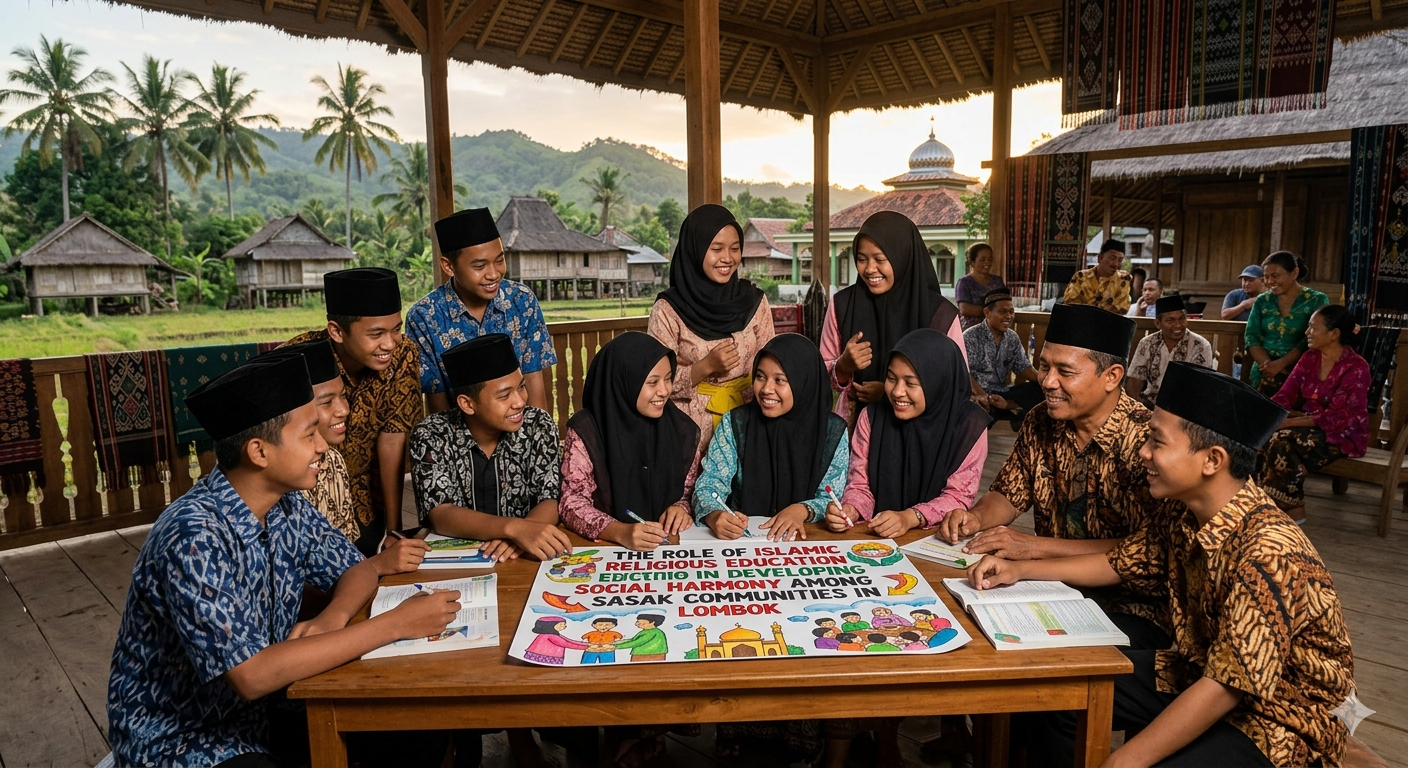
The Role of Islamic Religious Education in Developing Social Harmony among Sasak Communities in Lombok
Keywords:
Islamic religious education, social harmony, Sasak community, local wisdom, LombokAbstract
Purpose – This study investigates the role of Islamic religious education in developing social harmony among Sasak communities in Lombok. The research emphasizes the contribution of religious learning in maintaining peaceful social interaction within culturally diverse communities.
Design/methods/approach – The study used a qualitative descriptive method involving interviews with Islamic education teachers, religious leaders, youth organizations, and community members from Sasak communities in Lombok. Data were supported by field observations and analysis of local educational documents.
Findings – The results indicate that Islamic religious education strengthened communal solidarity, promoted moderate religious understanding, and enhanced cooperation between different social groups. Approximately 77% of participants acknowledged that religious educational activities contributed positively to conflict prevention and social cohesion. However, differences in religious interpretation among small groups occasionally created social tensions within the community.
Research implications/limitations – The study was limited to several Sasak communities in Lombok and therefore may not fully represent broader minority or indigenous contexts in Indonesia. The findings imply the importance of strengthening contextual Islamic education approaches rooted in local cultural wisdom.
Originality/value – This study contributes to discussions on Islamic education and local culture by highlighting the role of religious education in preserving social harmony among indigenous Muslim communities.
Published
How to Cite
Issue
Section
License

This work is licensed under a Creative Commons Attribution-ShareAlike 4.0 International License.
Authors who publish with Al Huda: Journal of Islamic Education and Society agree to the following terms:
- Authors retain copyright and grant the journal right of first publication with the work simultaneously licensed under a Creative Commons Attribution-ShareAlike 4.0 International License that allows others to share the work with an acknowledgment of the work's authorship and initial publication in this journal.
- Authors are able to enter into separate, additional contractual arrangements for the non-exclusive distribution of the journal's published version of the work (e.g., post it to an institutional repository or publish it in a book), with an acknowledgment of its initial publication in this journal.
- Authors are permitted and encouraged to post their work online (e.g., in institutional repositories or on their website) prior to and during the submission process, as it can lead to productive exchanges, as well as earlier and greater citation of published work (See The Effect of Open Access).