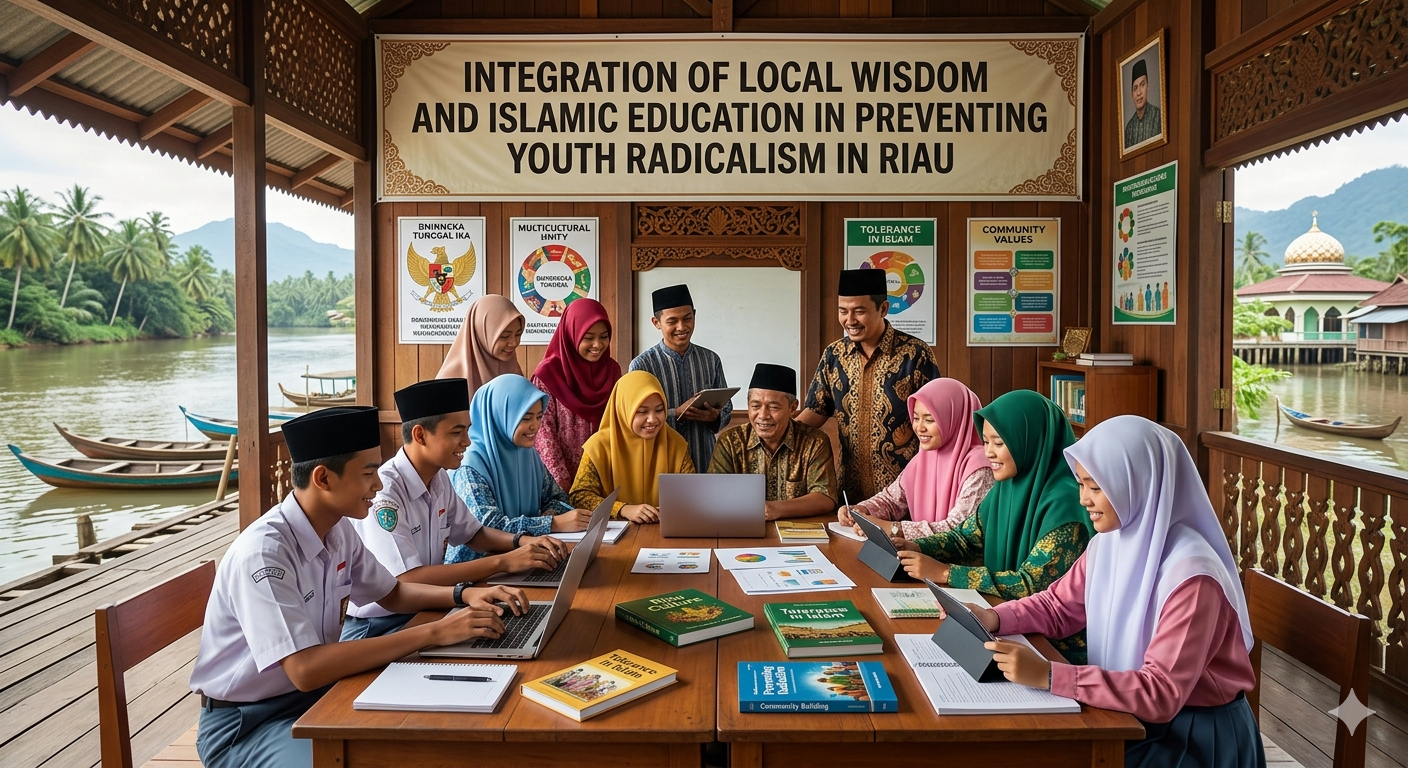
Integration of Local Wisdom and Islamic Education in Preventing Youth Radicalism in Riau
Keywords:
Islamic educatio, local wisdom, youth radicalism, religious moderation, RiauAbstract
Purpose – This study examines the integration of local wisdom and Islamic education in preventing youth radicalism in Riau. The research aims to analyze how culturally based Islamic educational approaches contribute to strengthening moderate religious perspectives among young people.
Design/methods/approach – A qualitative research design was employed through interviews with Islamic education teachers, youth leaders, religious scholars, and students in several Islamic schools in Riau. Data collection also included observations and curriculum document analysis.
Findings – The findings reveal that integrating local cultural values into Islamic education encouraged students to develop moderate attitudes, reject violent extremism, and strengthen social responsibility. Approximately 83% of respondents believed that local wisdom-based religious education effectively reduced exposure to radical narratives among youth. Nevertheless, the rapid spread of online extremist content remained a challenge for educational institutions.
Research implications/limitations – This study focused on selected schools and youth communities in Riau and may not represent all regional educational contexts in Indonesia. The findings highlight the importance of integrating local cultural identity into Islamic educational curricula as a strategy for preventing radicalism.
Originality/value – This study provides new insights into the relationship between Islamic education, local wisdom, and youth deradicalization within contemporary Indonesian society.
Published
How to Cite
Issue
Section
License

This work is licensed under a Creative Commons Attribution-ShareAlike 4.0 International License.
Authors who publish with Al Huda: Journal of Islamic Education and Society agree to the following terms:
- Authors retain copyright and grant the journal right of first publication with the work simultaneously licensed under a Creative Commons Attribution-ShareAlike 4.0 International License that allows others to share the work with an acknowledgment of the work's authorship and initial publication in this journal.
- Authors are able to enter into separate, additional contractual arrangements for the non-exclusive distribution of the journal's published version of the work (e.g., post it to an institutional repository or publish it in a book), with an acknowledgment of its initial publication in this journal.
- Authors are permitted and encouraged to post their work online (e.g., in institutional repositories or on their website) prior to and during the submission process, as it can lead to productive exchanges, as well as earlier and greater citation of published work (See The Effect of Open Access).