
Implementation of Inclusive Islamic Education for Strengthening Religious Moderation in East Java Madrasah
Keywords:
inclusive Islamic education, religious moderation, madrasah, tolerance, East JavaAbstract
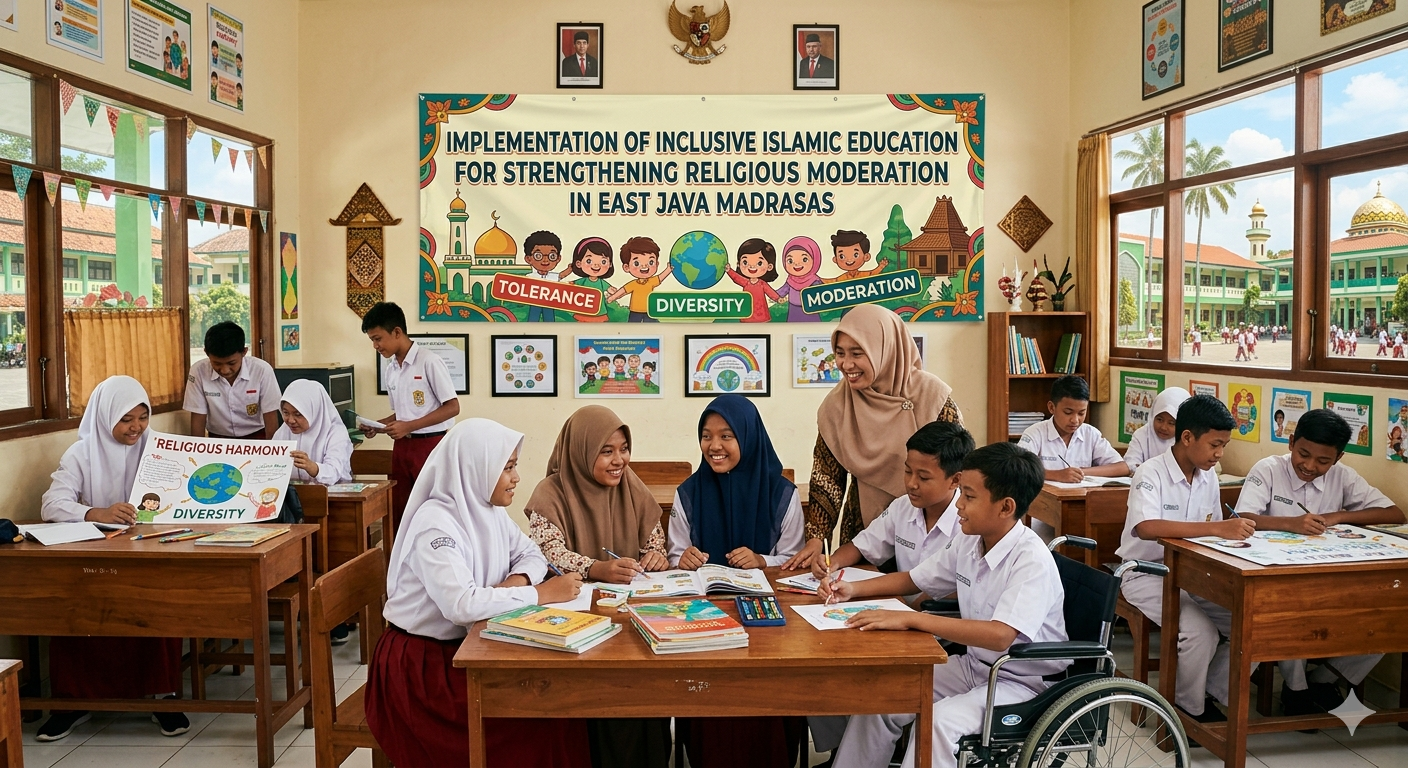
Purpose – This study analyzes the implementation of inclusive Islamic education in strengthening religious moderation within madrasahs in East Java. The research investigates how inclusive educational practices foster tolerant attitudes and peaceful coexistence among students from diverse social backgrounds.
Design/methods/approach – The study adopted a qualitative descriptive approach involving interviews with madrasah principals, teachers, students, and education stakeholders in East Java. Data collection methods included observations of classroom learning and institutional policy analysis.
Findings – The findings indicate that inclusive Islamic education significantly contributed to strengthening students’ understanding of religious moderation, tolerance, and democratic values. Approximately 85% of participants stated that inclusive learning activities improved social interaction and reduced discriminatory attitudes among students. However, unequal teacher competencies in implementing inclusive pedagogy remained a challenge in several institutions.
Research implications/limitations – This study focused on selected madrasahs in East Java and may not fully reflect conditions in other provinces. The findings imply the necessity of enhancing teacher training programs related to inclusive and moderate Islamic educational approaches.
Originality/value – This study contributes to the growing literature on inclusive Islamic education by providing empirical evidence regarding its effectiveness in promoting religious moderation within formal Islamic educational institutions.
Published
How to Cite
Issue
Section
License

This work is licensed under a Creative Commons Attribution-ShareAlike 4.0 International License.
Authors who publish with Al Huda: Journal of Islamic Education and Society agree to the following terms:
- Authors retain copyright and grant the journal right of first publication with the work simultaneously licensed under a Creative Commons Attribution-ShareAlike 4.0 International License that allows others to share the work with an acknowledgment of the work's authorship and initial publication in this journal.
- Authors are able to enter into separate, additional contractual arrangements for the non-exclusive distribution of the journal's published version of the work (e.g., post it to an institutional repository or publish it in a book), with an acknowledgment of its initial publication in this journal.
- Authors are permitted and encouraged to post their work online (e.g., in institutional repositories or on their website) prior to and during the submission process, as it can lead to productive exchanges, as well as earlier and greater citation of published work (See The Effect of Open Access).