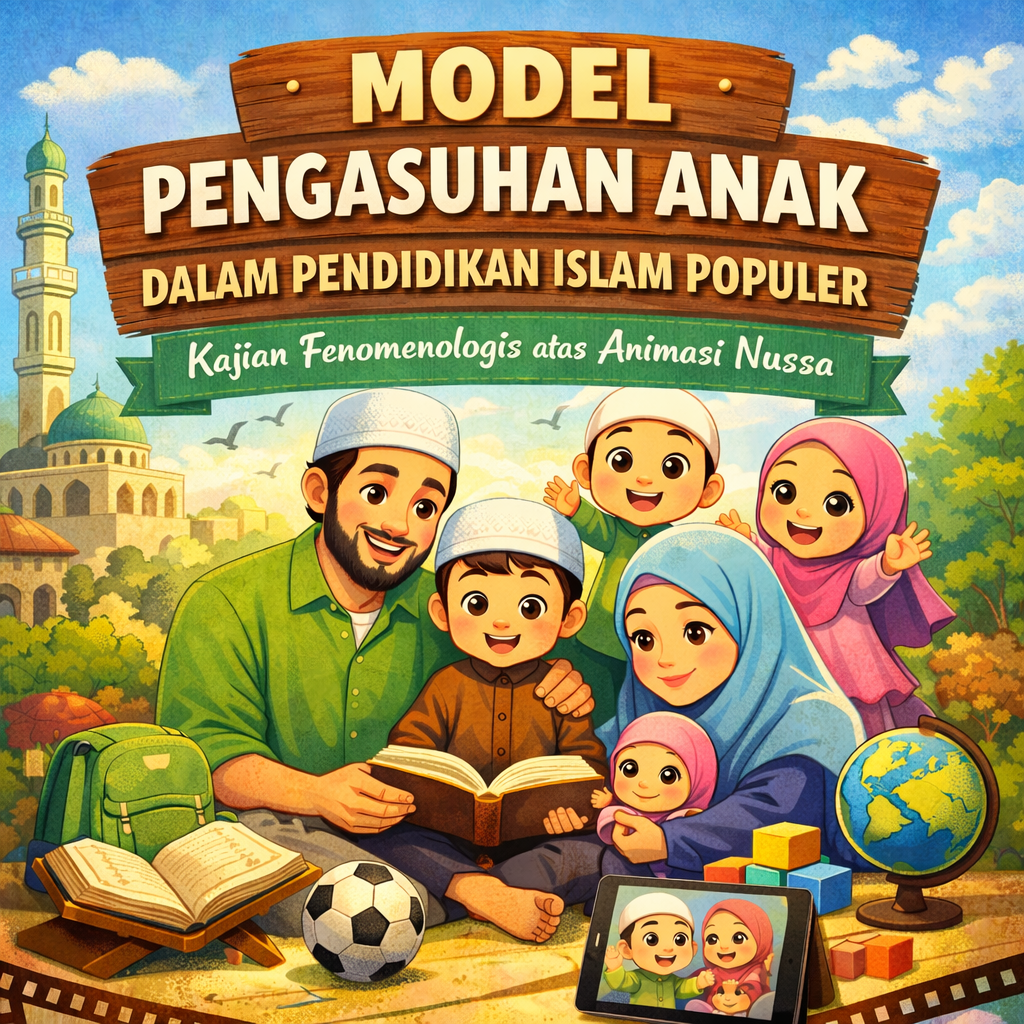
MODEL PENGASUHAN ANAK DALAM PENDIDIKAN ISLAM POPULER
Kajian Fenomenologis atas Animasi Nussa
Keywords:
Pendidikan Islam Populer, Parenting Islami, Animasi Anak, Islamisme, NussaAbstract
Tujuan – Penelitian ini bertujuan untuk menganalisis bagaimana model pengasuhan anak direpresentasikan dan direproduksi dalam pendidikan Islam populer melalui animasi Nussa. Studi ini dilakukan untuk memahami alasan munculnya pola parenting Islami tertentu di media digital anak serta relevansinya dengan dinamika religiusitas Muslim kelas menengah di Indonesia pascareformasi.
Desain/metode/pendekatan – Penelitian ini menggunakan pendekatan kualitatif dengan metode fenomenologis. Data utama diperoleh dari 30 episode musim pertama animasi Nussa. Data dianalisis secara interpretatif menggunakan analisis wacana deskriptif untuk mengungkap makna, nilai, dan praktik pengasuhan anak yang dikonstruksikan melalui narasi, visual, dan dialog animasi.
Temuan – Penelitian ini menemukan bahwa animasi Nussa mereproduksi nilai-nilai Islamisme populer yang mengarah pada penguatan perspektif Salafisme dalam pengasuhan anak usia dini. Nilai-nilai tersebut ditampilkan melalui model parenting yang menekankan ketaatan normatif, disiplin moral, dan otoritas religius keluarga. Model ini diposisikan sebagai alternatif sekaligus kompetitor bagi model pengasuhan lain dalam ruang pendidikan Islam kontemporer.
Implikasi/keterbatasan penelitian – Penelitian ini terbatas pada satu objek animasi dan belum melibatkan respons audiens secara empiris, sehingga generalisasi temuan perlu dilakukan secara hati-hati.
Orisinalitas/nilai – Studi ini menawarkan kontribusi baru dalam kajian pendidikan Islam dan studi sosial-keagamaan dengan menempatkan animasi anak sebagai arena kontestasi identitas keagamaan dan otoritas parenting Islami di era digital.
References
Anwar, H., & Huda, K. (2025). Model Integrasi keilmuan islam dan sains dalam pembelajaran fisika di Madrasah Aliyah. Al Huda: Journal of Islamic Education and Society, 1(1), 42-63. Retrieved from https://ejournal.maronpublishing.com/index.php/alhuda/article/view/41
Arifianto, A. R. (2020). Rising Islamism and the struggle for Islamic authority in post‐reformasi Indonesia. Asian Survey, 60(2), 1–25. https://doi.org/10.1525/as.2020.60.2.1
Baumrind, D. (1991). The influence of parenting style on adolescent competence and substance use. Journal of Early Adolescence, 11(1), 56–95. https://doi.org/10.1177/0272431691111004
Bennett, L. (2015). Women, Islam, and modernity: Single women, sexuality, and reproductive health in contemporary Indonesia. Routledge.
Bourdieu, P. (1990). The logic of practice. Stanford University Press.
Campbell, H. (2013). Digital religion: Understanding religious practice in new media worlds. Routledge.
Creswell, J. W. (2014). Research design: Qualitative, quantitative, and mixed methods approaches (4th ed.). Sage.
Fealy, G., & White, S. (2008). Expressing Islam: Religious life and politics in Indonesia. ISEAS Publishing.
Foucault, M. (1980). Power/knowledge: Selected interviews and other writings. Pantheon Books.
Heryanto, A. (2018). Identitas dan kenikmatan: Politik budaya layar Indonesia. Kepustakaan Populer Gramedia.
Hidayati, N. (2025). Peran Pesantren dalam Pemberdayaan Ekonomi Masyarakat Berbasis Wakaf Produktif. Al Huda: Journal of Islamic Education and Society, 1(1), 64-84. Retrieved from https://ejournal.maronpublishing.com/index.php/alhuda/article/view/39
Hoesterey, J. B. (2016). Rebranding Islam: Piety, prosperity, and a self-help guru. Stanford University Press.
Hoesterey, J. B., & Clark, M. (2012). Film Islami: Gender, piety and populism in post-authoritarian Indonesia. Asian Studies Review, 36(2), 207–226. https://doi.org/10.1080/10357823.2012.685925
Jati, W. R. (2015). Less cash society: Menakar mode konsumsi baru kelas menengah Muslim Indonesia. Jurnal Sosiologi Reflektif, 9(2), 1–22. https://doi.org/10.14421/jsr.v9i2.1143
Kamil, S., et al. (2011). Islam dan demokrasi di Indonesia. CSRC UIN Jakarta.
Kellner, D. (1995). Media culture: Cultural studies, identity and politics between the modern and the postmodern. Routledge.
Livingstone, S. (2009). Children and the internet: Great expectations, challenging realities. Polity Press.
Mahmood, S. (2005). Politics of piety: The Islamic revival and the feminist subject. Princeton University Press.
Munastiwi, E. (2021). Parenting Muslim kelas menengah di era digital. Jurnal Pendidikan Islam, 10(1), 45–60. https://doi.org/10.14421/jpi.2021.101.45-60
Nasrullah, R. (2017). Media sosial: Perspektif komunikasi, budaya, dan sosioteknologi. Simbiosa Rekatama Media.
Nisa, E. F. (2018). Creative and lucrative Daʿwa: The visual culture of Instagram amongst female Muslim youth in Indonesia. Asiascape: Digital Asia, 5(1–2), 68–99. https://doi.org/10.1163/22142312-12340085
Rahman, F. (2025). Dinamika Interaksi Sosial Muslim Minoritas di Wilayah Plural: Studi Kasus Pendidikan Karakter di Sekolah Islam Kota Ambon. Al Huda: Journal of Islamic Education and Society, 1(1), 23-41. Retrieved from https://ejournal.maronpublishing.com/index.php/alhuda/article/view/40
Rakhmani, I. (2016). Mainstreaming Islam in Indonesia: Television, identity, and the middle class. Palgrave Macmillan. https://doi.org/10.1057/9781137504646
Rinaldo, R. (2013). Mobilizing piety: Islam and feminism in Indonesia. Oxford University Press.
Said, E. W. (1978). Orientalism. Pantheon Books.
Salvatore, A. (2007). The public sphere: Liberal modernity, Catholicism, Islam. Palgrave Macmillan.
Siregar, R. (2025). Strategi dakwah dan edukasi di media sosial untuk generasi z: Analisis konten dakwah kreatif di tiktok. Al Huda: Journal of Islamic Education and Society, 1(1), 85-108. Retrieved from https://ejournal.maronpublishing.com/index.php/alhuda/article/view/43
van Bruinessen, M. (2013). Contemporary developments in Indonesian Islam. ISEAS Working Paper, 1–20.
Weber, M. (2002). The Protestant ethic and the spirit of capitalism. Routledge.
Yusuf, M. (2017). Islamic media and popular piety in Indonesia. Journal of Indonesian Islam, 11(1), 1–26. https://doi.org/10.15642/JIIS.2017.11.1.1-26
Zainuddin, A. (2025). Transformasi Kurikulum Pendidikan Islam di Era Digital: Integrasi Nilai Keislaman dan Literasi Teknologi. Al Huda: Journal of Islamic Education and Society, 1(1), 1-22. Retrieved from https://ejournal.maronpublishing.com/index.php/alhuda/article/view/38
Zaman, M. Q. (2002). The ulama in contemporary Islam. Princeton University Press.
Zubair, A. (2020). Islamic parenting and moral education in Indonesia. International Journal of Islamic Educational Studies, 3(2), 88–104. https://doi.org/10.51483/IJIES.3.2.2020.88-104
Downloads
Published
How to Cite
Issue
Section
License
Copyright (c) 2026 Putri Isma Indriyani

This work is licensed under a Creative Commons Attribution-ShareAlike 4.0 International License.
Authors who publish with Al Huda: Journal of Islamic Education and Society agree to the following terms:
- Authors retain copyright and grant the journal right of first publication with the work simultaneously licensed under a Creative Commons Attribution-ShareAlike 4.0 International License that allows others to share the work with an acknowledgment of the work's authorship and initial publication in this journal.
- Authors are able to enter into separate, additional contractual arrangements for the non-exclusive distribution of the journal's published version of the work (e.g., post it to an institutional repository or publish it in a book), with an acknowledgment of its initial publication in this journal.
- Authors are permitted and encouraged to post their work online (e.g., in institutional repositories or on their website) prior to and during the submission process, as it can lead to productive exchanges, as well as earlier and greater citation of published work (See The Effect of Open Access).